

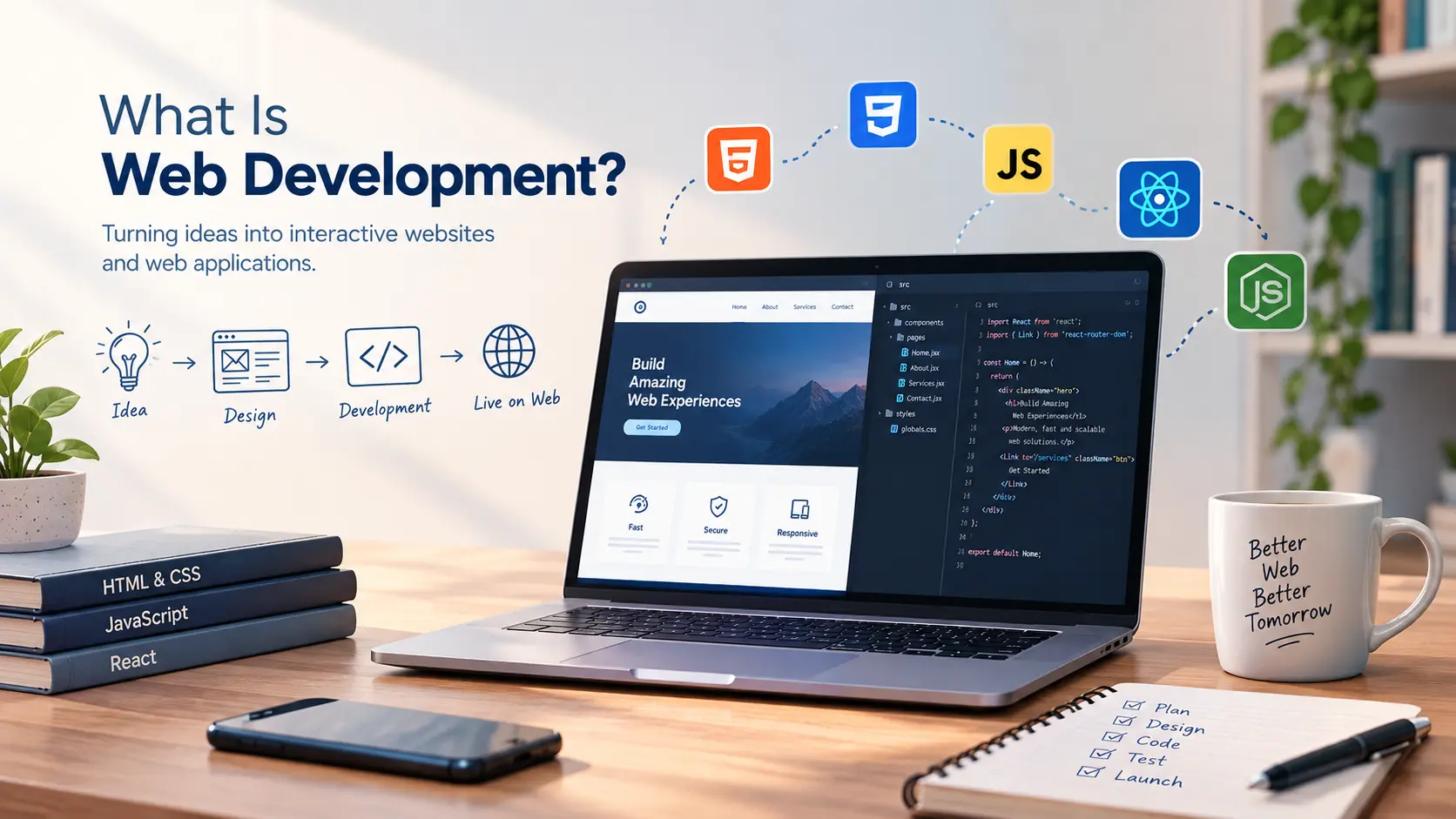
Web development is the process of planning, building, testing, deploying and maintaining websites, web applications and web based software systems. Various programming languages are used to create the functionality of the website, while security, performance and maintenance are also part of the job.
Website development can range from a simple business website to a web app that allows users to log in and access custom features. More advanced web solutions connect databases, APIs and other systems.
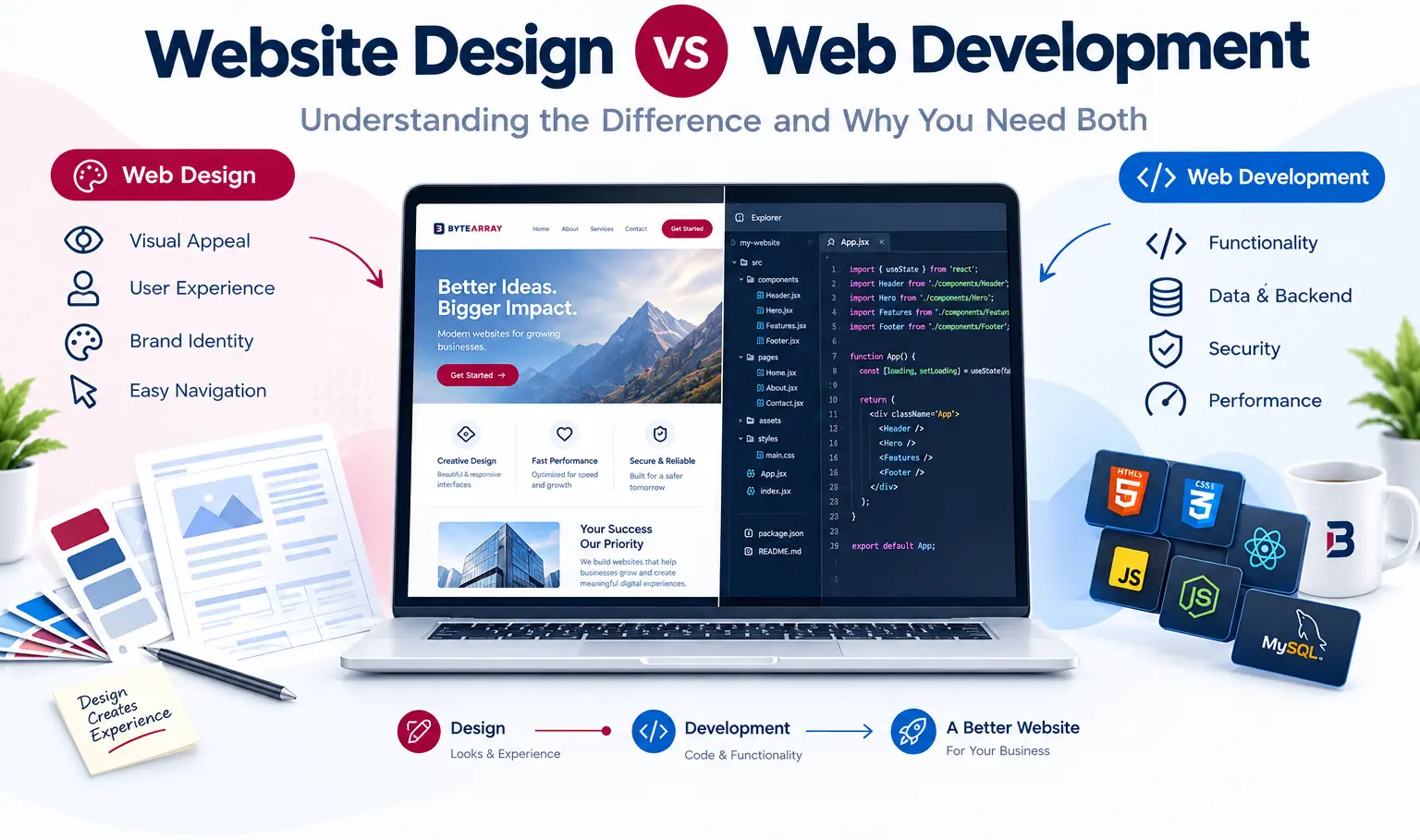
Web development differs from web design in a significant way. While web design deals mainly with UI and UX, development implements these domains along with server side programming to create a digital product.
How Does Web Development Work?
It integrates the web browser on the client side with the web server, database and application programming interface. Here are the basic steps when someone enters a website:
- Web browser requests a web page: The request uses HTTP format to retrieve a web page.
- DNS locates the server: The website address in www format is translated to the server location using the Domain Name System (DNS) service.
- Server processes the request: The web server delivers the request to the server application.
- Data is retrieved: The information is retrieved from the database or API.
- Browser displays the result: The web page is displayed in the browser using HTML, CSS and JavaScript.
While a static webpage serves prebuilt content, a dynamic website processes client side requests to update content in real time.
What Are the Main Types of Web Development?
The field is divided into three main types:
- Front end
- Back end
- Full Stack
These three types of web development work together to deliver a comprehensive digital experience.
| Type | Focus | Examples |
|---|---|---|
| Front end | Building user interfaces and user interactions in the web browser | HTML, CSS, JavaScript, React |
| Back end | Handles server transactions, business logic, database, data processing and APIs | Node.js, Python, PHP |
| Full Stack | Integrated front end and back end for a complete web solution | Front end + back end |
All three types of web development are interconnected. The front end provides the interface, back end manages the data, while full stack brings both sides together.
What Other Specialised Services Do Businesses Use?
Businesses use specialised forms of development that go beyond front end, back end and full stack operations.
Different services can be used to address specific customer requirements, business processes and digital objectives:
- Ecommerce development: Used for online shopping, payment transactions, online shopping carts, order management and customer data.
- Web application development: Includes interactive SaaS platforms, customer web pages, dashboards and custom business systems.
- CMS development: Creates, organises and updates website content known as a content management system.
- API development: Allows a website to use services such as CRM, ERP, payment gateways or any other application.
- Headless development: Separates front end from the backend system, allowing content to be delivered across multiple channels.
- Progressive Web Apps (PWAs): Makes the web experience more like an app with fast, responsive functions.
Together, these services allow businesses to build digital experiences around their specific customers, processes and technology requirements.
Which Technologies Are Used to Build a Website?
A website relies on a combination of core technologies, each serving a different purpose. The right combination depends on the project's requirements.
| Category | Examples | Purpose |
|---|---|---|
| Core technologies | HTML, CSS, JavaScript, TypeScript | Build the web experience |
| Frameworks | React, Angular | Build interfaces and apps |
| Back end | Node.js, Python, PHP, Java | Server side functionality |
| Databases | MySQL, PostgreSQL, MongoDB | Store and manage data |
| APIs | REST, GraphQL, third party integrations | Connect systems and services |
| Development tools | Git | Manage code and collaboration |
When considering the best technology stack, businesses should look at functionality, scalability, security, integrations, existing infrastructure and available development expertise for the most comprehensive outcome.
What Is the Web Development Process?
The process starts with business requirements and ends with a functioning web solution.
Most projects follow six key stages as described below:
- Discovery and Planning: Starts with defining goals, target users, required functions, scope, technology and system integrations.
- Design and Information Architecture: The sitemap, wireframes and UI/UX are put in place. At this time, responsive layouts and multi device compatibility are ensured.
- Development: Front end and back end stacks are developed. Databases, APIs and web browsers are connected with all the functionality.
- Testing and SEO: The website is tested for performance, accessibility and security. This is a good time to incorporate technical SEO.
- Deployment: Hosting, domain and DNS configuration along with SSL, backups and final checks are completed.
- Maintenance: Ongoing maintenance includes security updates, bug fixes, monitoring, performance optimisation and new features as business needs evolve.
What Does a Full Service Project Include?
A full service project covers the complete project lifecycle, from discovery and design through development, testing and deployment to ongoing maintenance.
This web services development approach gives businesses a single partner responsible for coordinating multiple technical requirements and stages of the project, holistically.
Why Does Professional Development Matter for Businesses?
Professional development work gives a business more than an online presence, with a host of benefits for long term growth.
- Builds credibility and trust: Customers gain trust in the business. A professional, secure website makes customers confident in doing business with the company.
- Improves customer experience: It's easier for users to find information on products or services and to interact with a business to complete tasks.
- Generates leads and conversions: Supports lead generation, enquiries, bookings and sales.
- Supports ecommerce: Online stores serve to list products, perform sales and payments and manage customer accounts.
- Enables automation: Manual work is reduced with web applications that can automate repetitive tasks.
- Connects business systems: Web solutions can link the user with back end applications such as databases and APIs.
- Improves security and reliability: Protects data and maintains dependable digital services.
- Supports scalability: Adapts as traffic, customers, functionality and business requirements grow.
How Much Does a Website Project Cost and How Long Does It Take?
Cost and timeline depend on the project scope, tech stack, functionality and exact project requirements.
Here is an outlook on some common projects and how cost and time depend on various factors.
| Project | Cost and Time Factors |
|---|---|
| Business website | Number of pages, CMS, forms and content |
| Ecommerce | Products, payments, orders and customer accounts |
| Customer portal | User accounts, permissions and system integrations |
| Web application | Custom functionality, data, integrations and scalability |
How Should a Business Choose an Approach?
Choose an approach based on requirements rather than tech. Consider all aspects of the business such as objectives, target users, integrations, expected traffic and budget.
For example, for applications to create, manage and update website content, a CMS tool is appropriate. Custom development may be required for complex workflows and specialised integrations. On the other hand, web applications are best suited to platforms requiring transactions or personalised data.
To find the right approach, ask a prospective agency the following questions:
- What technology stack do you recommend and why?
- Who owns the source code?
- What is included after launch?
- How will security, SEO and scalability be handled?
Best Practices and Common Mistakes to Avoid
Get the best performance, usability, security and reliability with these best practices:
| Do | Don't |
|---|---|
| Build responsive, user friendly web solutions | Start without clear requirements |
| Consider SEO and core web vitals like traffic | Implement SEO after launch |
| Optimise security and performance | Ignore accessibility and data security |
| Use version control, backups and updates | Overlook integrations with systems |
| Plan for scalability and maintenance | Launch with support as an afterthought |
| Choose tech stack based on business problem | Choose tech stack before understanding the requirements |
Build Your Web Solution with ByteArray Technology Solutions
ByteArray Technology Solutions provides custom web development services for businesses, brands and agencies from startups to large enterprises.
We are well versed in creating business websites, ecommerce stores and customised web solutions. Our team focuses on responsive design, performance, security, SEO friendly development and scalability, with support extending from requirements and planning through development, testing, launch and maintenance.
Businesses looking for a full service partner can choose ByteArray Technology Solutions to create a reliable, user friendly digital solution with modern technology and best design practices.





Leave a comment